D D Kosambi and His History of Ancient India: The Mysteries of the IVC
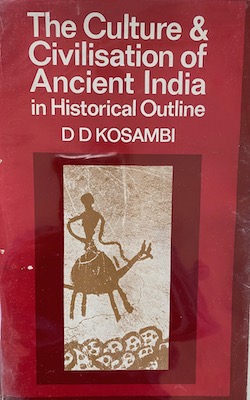
A few years ago I came across the name D D Kosambi in a book on Indian History that I was reading at that time. The writer mentioned Kosambi’s un-orthodox methods of researching Ancient Indian History by going out into the rural countryside outside Pune, the town where he lived, and talking with the villagers. Intrigued, I ordered his book The Culture and Civilization of Ancient India, and it turned out to be one of the finest books on this subject that I had come across. This book, that was published in 1965, covered the History of India from pre-historic times to about the beginning of the Christian Era and was full of penetrating insights on Indian History that I hadn’t seen anywhere else. In this blog post I want to focus Kosambi’s exposition on the Indus Valley Civilization (IVC) which forms Chapter 3 in his book. This book was written in the 1950s, and since then some of the mysteries of this civilization that Kosambi talked about have been answered with new archeological evidence. But the greater impact has come from the new gene sequencing technology that has become available in the last ten years. In October of 2019, a team of researchers published the paper An Ancient Harappan Genome Lacks Ancestry from Steppe Pastoralists or Iranian Farmers, it was a follow-on to an earlier paper by the same group The Formation of Human Populations in South and Central Asia that was published a month earlier. These papers shed new light on the genetic background of the people who lived in the IVC and their connection to the modern Indian population. They showed that the current population of India has inherited about 50%-60% of its genetic makeup from the people of the IVC, with the remainder coming from a mixture of Indo-European tribes and the original tribal inhabitants of the subcontinent (henceforth referred to as the Adivasis). Hence in a very real sense we Indians are all the children of the IVC. This sparked my interest in finding out more about this mysterious civilization and its origins in the remote past.
Kosambi proposed a number of theories about the IVC based on data that he had, and I will attempt to find out how these theories have fared in light of the new evidence. Before I launch into history, a few words on Kosambi, the man himself. I was surprised to learn that by profession Kosambi was a mathematician. In fact he made a notable contribution to the field of Stochastic Processes, and there is a result to his name called the Kosambi-Karhunen-Loeve Expansion. I knew this result from my graduate student days as the Karhunen-Loeve expansion, it was used extensively in a Estimation and Detection Theory, which is a part of Digital Communications theory. Kosambi discovered this result a few years before Karhunen and Loeve, and more modern citations are increasingly including his name. Kosambi also contributed to the field of Numismatics, which is the study of ancient coins. Since Ancient Indians were not very particular about recording their history, the only information that we have about large stretches of Indian History are the coins from those periods. By applying modern statistical methods Kosambi was able to garner a lot of information from these coins, and his book abounds with these insights. Kosambi’s interest in Ancient History was a side effect of his Numismatics work and took most of his time in the later years of his life. He died at the relatively young age of 59 in 1966.
Kosambi on the IVC
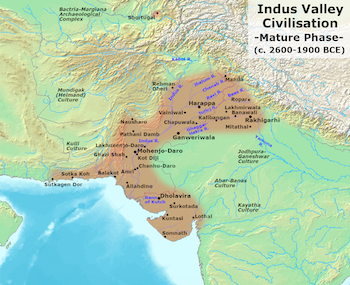
The transition from tribal hunter-gatherer stage to agricultural urban societies was a pivotal one in human history. Until a hundred years ago, we knew of only three civilizations from the 3rd millennium BCE that had made this transition, the Egyptian, the Sumerian and the Chinese, all located along river valleys. The IVC is the newest addition to this group and was unknown till about a hundred years ago. The map above shows the maximum geographical extent of the IVC, which was quite extensive, much larger than the sister civilizations of Egypt and Sumer that existed at that time. It was mostly located along the valley of the Indus River and its tributaries, though it extended as far down as coastal Gujarat and even Maharashtra to the South. At that time peninsular and eastern India was covered by a dense forest which could not be cleared using the bronze implements that the IVC had, which constrained their expansion into the Gangetic plane.
The IVC existed in the time period 3300 BCE to 1700 BCE, with the period 2700-1900 BCE defined as the Mature Phase of the civilization. During this phase the IVC cities took on a standard appearance, with a common script. This script has not been deciphered unfortunately, so we don’t know what they called themselves, though Sumerian documents refer to the country of Meluhha in the East with whom they had trade relations, and this could very well be their name. All mention of Meluhha came ended after 1750 BCE which coincides with the date at which the IVC came to an end. Incidentally it is thought that the Sanskrit Mlecha, which refers to an outcast was probably derived from Meluhha. Indeed, when I was growing up in a small town in Eastern Bihar, I remember my mother using the term Mlech when she was particularly upset with one of the servants at our home. The Rigveda that was compiled in the period 1500-1000 BCE is mostly silent about the IVC people or their cities, with a few cryptic exceptions. According to Kosambi, the main non-Aryan people named in the Rigveda were the Panis. He theorised that the Sanskrit vanik comes from Pani, and this later became the modern bania. Other clues include the fact that the word coin is pana in Sanskrit, and trades, good and commodities are known as panya. The people of the IVC were very active traders and merchants with a network that extended into Mesopotamia, and there is a possibility that some of them continued these activities in later times as well.
The IVC was defined by its cities which featured advanced urban planning not seen anywhere else in the world at that time, and in stark contrast to more modern Indian cities (or for that matter in the West). These included wide boulevards laid down in a grid pattern with brick houses neatly arranged along the sides. Each house had a bathroom and so there were channels for supplying water to them and carrying away wastewater. The bricks used for construction were of the sturdy kiln-fired type, with dimensions that are still used in India today. Moreover, their larger cities such as Mohenjo-Daro and Harappa had similar urban layouts, so it seems they applied the same master-plan in several places. There were some houses that were larger than others, which would qualify as the homes of the well off. But by and large every house had the basic amenities, which points to a highly egalitarian society. The sister civilizations that existed at the that time, namely the Sumerian and Egyptian, in contrast had a rigid hierarchy with the rulers living in splendid luxury in large palaces. It was though that such a hierarchy was necessary for a civilization to progress from the tribal stage to settled urban cities, but the IVC does not conform to this pattern. There is no evidence of a king, nobility or even organized religion in the remains of the IVC.
The people of the IVC practiced agriculture and grew several cereal crops including wheat, barley and supplemented by pulses, sesame, peas and vegetables. It is thought that they discovered agriculture independently of the so-called Anatolian farmers in the Golden Crescent area of the Middle East and the Chinese, since there is no genetic evidence of the movement of people from either of these regions into the Indus Valley. Their diet would be familiar to the people of modern India and even featured spices such as turmeric. Their fields were watered by the waters of the rivers in the area, and they took advantage of the silt that was deposited in the annual flooding to fertilize the soil. However, unlike the Sumerians they did not build a canal system for irrigation, instead they relied on crude dams to store water from the rivers.
IVC was a merchant civilization and they had extensive trade link with other civilizations from that time, especially with the Sumerians. The exports from the IVC included luxury items such as peacocks, ivory and ivory articles such as combs, apes, pearls, bead necklaces and cotton textiles. Seals from the IVC have been found in the Sumerian capital of Ur, on the island of Bahrain and even on the coast of Africa. Kosambi thought that these trade links were by sea, so that the IVC had mastered ocean navigation to other ports along the Arabian Sea. As evidence he pointed to some IVC seals that have pictures of boats. His theory was that navigation was done by staying close to the shore at all times, and also by using releasing a crow to figure out the direction leading to land (this technique was mentioned in one of the Jataka tales).
Origins of the IVC
One of the biggest mysteries about the IVC is their origin and their subsequent disappearance after their civilization collapsed. Based on the information available during Kosambi’s time, it seemed as though the sophisticated IVC cities appeared suddenly towards the beginning of the 3rd millennium BCE and were as mysteriously abandoned a thousand years later. There was almost no trace of the IVC in the written or oral records of the subsequent history of India, such as in the Vedas.
Kosambi speculated that the uniformity of the city designs showed that they were setup according to existing plans that were developed elsewhere and then bought in a finished state to the Indus Plains. He also made the very astute observation that perhaps the progenitors of the IVC lived in a rocky and hilly area when they were hunter-gatherers and once they developed agriculture and the basics of their urban civilization they moved to the flat river plane that was more amenable to large scale farming. This conjecture may have been borne out with the discovery of the ruins of Mehrgarh in Baluchistan which was excavated starting in 1974. In a hilly area at the edge of the Indus plain archaeologists discovered what looked like the progenitors to the IVC, with remains of an older hunter-gatherer stage followed by a farming community. Mehrgarh was occupied during the period 7000 BCE to 2000 BCE and there were similarities to the IVC in the artifacts discovered there. Archeologists have also discovered older smaller urban settlements in the deeper layers of the ruins of most of the larger IVC cities such as Harappa, which shows the cities evolved over time. However, in last 700 years of their existence they seem to have settled on a final urban design that was closely replicated in all their cities, and there was very little change from then on.
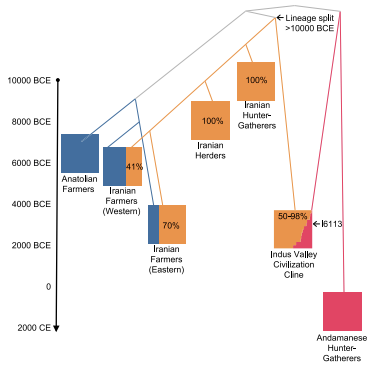
The other clue to the origins of the IVC came from genetic sequencing data and is reproduced above. The figure shows that people of the IVC had genes from two sources:
- Ancient hunter-gatherers who were related to the hunter-gatherers living on the Iranian plateau. As the figure shows the ancestors of the IVC split from the Iranian branch sometime before 10,000 BCE, well before the development of agriculture. Both these groups migrated to their final locations from an area whose location is not known. We will refer to this group as the Archaic IVC.
- Andamanese hunter-gatherers who represent the gene flow from the tribals, or Adivasis, of the Indian peninsula. These people came to India in one of the early human waves out of Africa around 50,000 BCE.
The admixture between the Archaic IVC and the Adivasis happened (with 95% confidence interval), in the period 5400 to 3700 BCE, well before the time of the mature IVC. Thus, the genetic evidence shows that the IVC population was not related to any other population that existed in the ancient world at that time, and may have lived in that area of North Western India since 10,000 BCE or even earlier.
What did the People of the IVC look like?
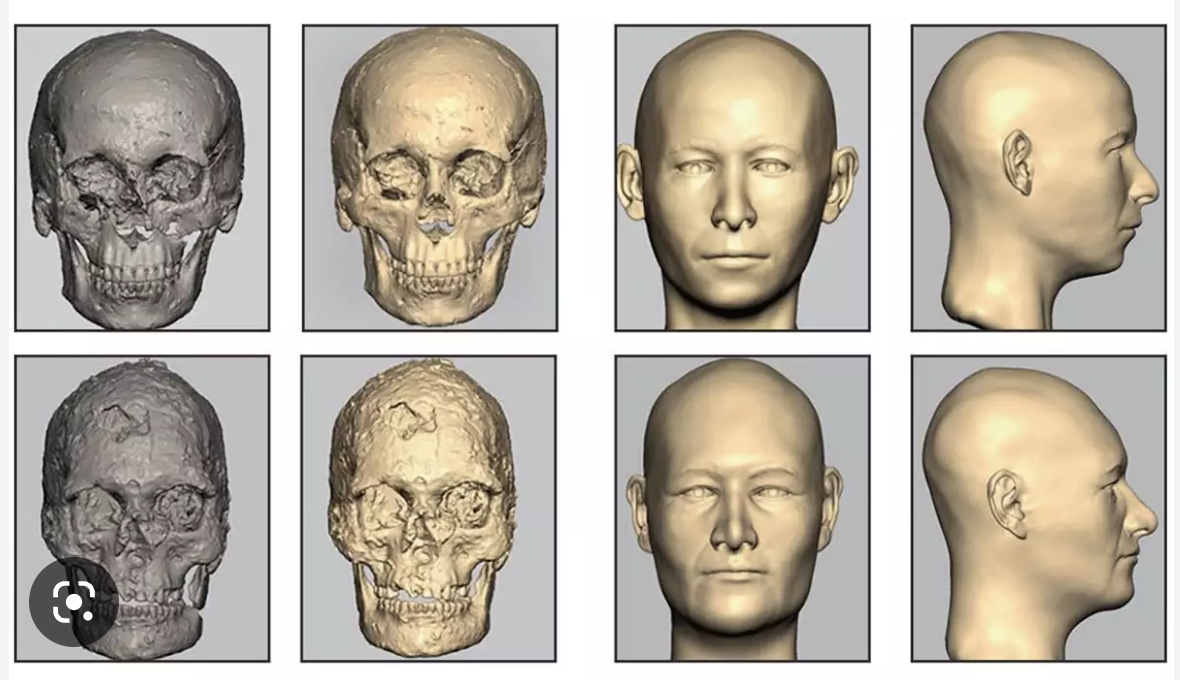
Rakhigiri near Delhi was one of the larger cities of the IVC. Archaeologists recovered the bones of 37 people who were buried in a cemetery there around 2500 BCE, and one of these yielded the DNA that was used to find out the genetic origins of the IVC people. The skulls of two of the other people were used to carry out an accurate facial representation shown above, using a Cranio-Facial reconstruction technique. The resulting facial features are not different from what one would find in a typical male Indian today.
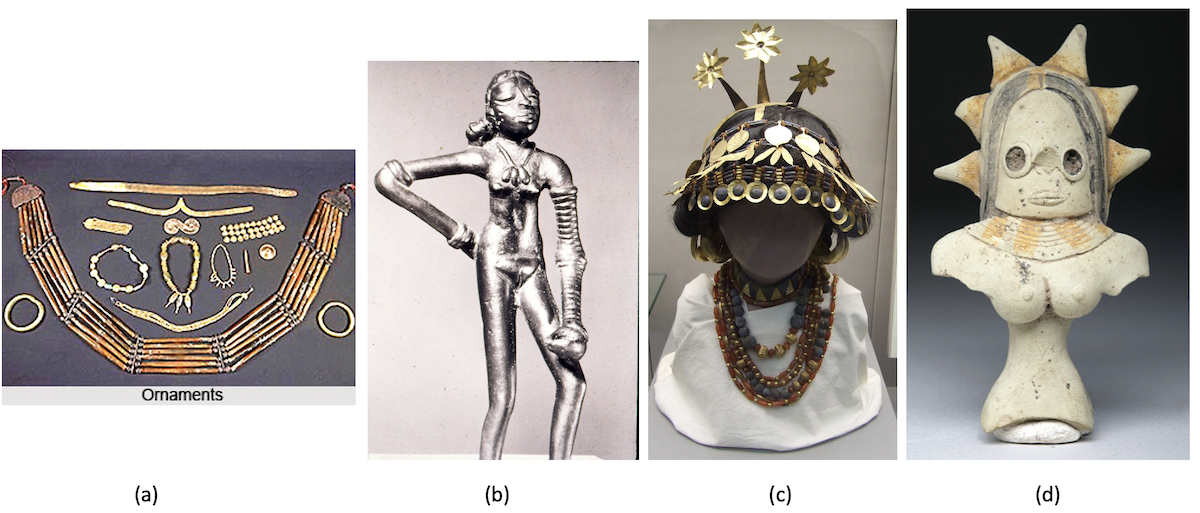
The IVC people were very fond wearing jewelry made from beadwork, as well as gold and silver. The excavations in the IVC cities have yielded an abundance of these objects and some examples of these are shown in image (a) above. A lot of work in collecting and analyzing beads from the IVC was done by the archaeologist Mark Kenoyer from the University of Wisconsin who did excavation work in Harappa for more than 30 years. Beads from the IVC was also one of their main export items have been found not only in Mesopotamia, but as far as Israel, Central Asia and Greece. According to Kenoyer:
Soft steatite beads made by the Indus craftspeople were manufactured in very specific ways, using thinner cuts made by a bronze saw with distinctive serrations. They were drilled with tiny copper drills and then ground to become micro beads, thousands of which were required to make a single ornament.
Image (b) is one of the most famous finds from Mohenjo-Daro. It is a copper figurine of a dancing girl bedecked with bangles and other jewelry. The objects in Image (c) were discovered in Sumer, but the beads displayed probably came from the IVC. Image (d) is another female figurine from the IVC showing prominent necklace and head gear.
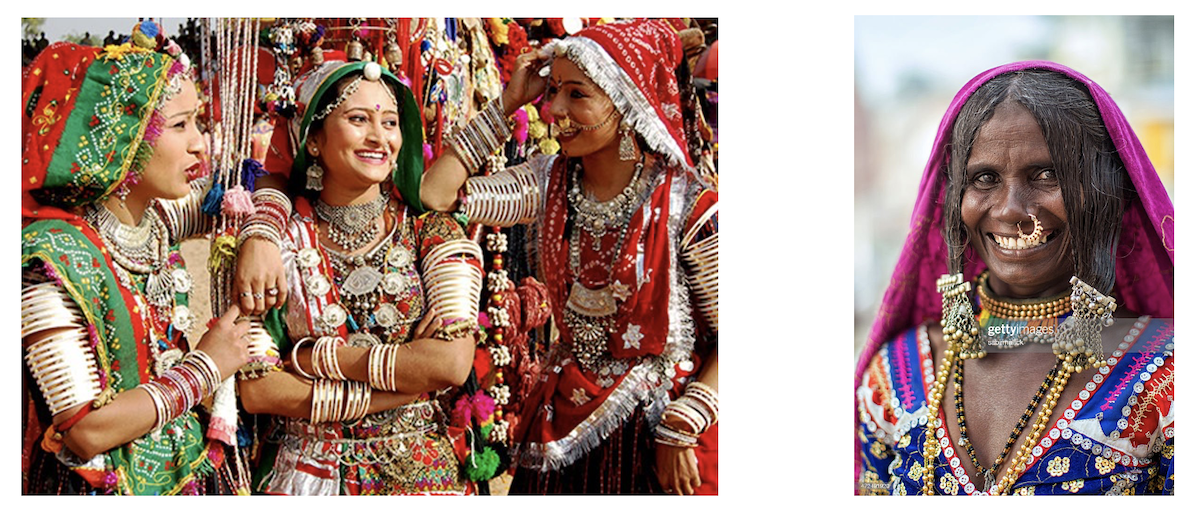
Indians of the current era are well known for their fondness for jewelry, and it is likely this is a trait that they inherited from their IVC forbearers. The images above are those of present-day tribal women from Rajasthan, bedecked in bangles, necklaces and bead jewelry of the type found in the IVC. This is probably a good representation of what a well-dressed woman from the IVC looked like.
How Were the Indus Cities Governed?
The ruins of the IVC have left us with almost no information about how the cities were governed or who the rulers were. Other civilizations have left written records about their kings, and it is also easy to identify their large palaces among the ruins. However, the uniformity of the all the IVC cities scattered over such a wide area, and the fact that artifacts such as seals and beads were identical everywhere, shows that there must have been some kind of central governing authority.
The transition from the hunter-gatherer stage to farming requires a ruling authority to co-ordinate the agricultural activities and distribute the surplus (to the non-farming part of the population), maintain irrigation infrastructure, defend the settlement from external invaders also to provide internal policing in the cities. Such an authority sustains itself by taxing its subjects which pays for its activities. Clearly such an authority existed in the IVC as well, but its nature was very different than those in Egypt or Sumer. The archeological data shows no signs of warfare between the IVC cities, and none of the recovered artifacts include robust weapons that could be used for this purpose. From this Kosambi surmises that whatever authority controlled the people did so without much force. Hence perhaps there was no warrior class in the IVC, but the cities were governed either by the merchant class or the religious authorities. There was another clue: He observed that there was a curious lack of change in the IVC cities for the last 700 years of their existence which is unlike any other civilization from that time. As he puts it:
The pottery, the tool types and the seals remained the same. The alphabet also was static, this was in strong contrast to India in the later historical period, where the forms of the letters varied so much from one century to the next that the script offers a fairly good method - sometimes the only know method - for dating manuscripts or inscriptions
Moreover even though IVC merchants were in regular contact with Mesopotamia, the IVC did not adopt any of the more advanced technology or practices that the Mesopotamians had: Such as writing on clay tablets, canal irrigation or deep ploughing for agriculture. From this Kosambi concludes that the land as a whole was not owned by the merchant class and hence they did not have any interest in agricultural improvements of the type seen in Mesopotamia. It follows that religious authorities in the IVC were oversaw the food supply and owned all the land. Kosambi further opined that like all ancient priesthoods, they prevented all innovation, which accounts for the stasis in their civilization. Hence
Religion, not prowess or violence, was the essential ideological force of the Indus society
I think there is a lot of truth to what Kosambi says, since this pattern occurs later in Indian history as well: Religious stagnation followed with violent periods of war. Kosambi has a lot more to say about this in later chapters of his book, in which he drew a parallel with the stagnation in Indian society after the end of the Gupta period in sixth century AD and the advent of the Afghan conquerors in the twelfth century.
Based on new archaeological discoveries that became available since the time of Kosambi, Mark Kenoyer reached the conclusion that: The cities were organized as state-level societies with highly stratified and hierarchical social organization. As evidence of this, he pointed out the following: Larger homes in a portion of the city that was separated from the regular houses, a small percentage of individuals who were buried in cemeteries with burial pottery and other offerings in contrast to the rest of the population that was probably cremated, limited use of seals, weights and writing by some communities living in the city and evidence of craft specialization within the cities.
On the other hand, Adam Green argues in this article published in 2020 that the IVC was an egalitarian civilization. So, this issue has not been settled yet, and may have to wait a decipherment of the Indus script.
How did the IVC come to an end?
There are two theories among the experts about how the IVC ended, and we will discuss both. The facts that we know about this event from archaeology are the following: Even though the major cities were showing signs of degradation over the course of a century or two before 1750 BCE, the end was sudden. The cities were abandoned around 1750 BCE and all trade connections with Mesopotamia came to an end. The dams that were used by the IVC for irrigation purposes were also destroyed and the land reverted back to desert. The Indus script and inscribed seals fell into disuse and writing disappeared along with cubical stone weights. Kosambi makes the point that other civilizations have often made a major transition, after being conquered for example, without completely collapsing. However, what kept them going was the fact that their agricultural infrastructure kept functioning, so that the farmers kept working on their fields irrespective of who the rulers were. However if the food supply stops due to an interruption in agriculture, then this can cause a complete collapse of the type we see for the IVC. There is a black hole in archaeological finds from the end of the IVC until about 1000 BCE when well made pottery re-appeared in remains of urban settlements in the region of the northern Ganges plain. This was of the type known as Painted Grey Ware (PGW) pottery, which is distinct from what was produced in the IVC. PGW pottery is associated with the Vedic Age, indeed the oldest veda, namely the the Rigveda was composed around this time.
Kosambi was of the opinion that the IVC ended due to the invasion of the Indo-European people (also known as the Yamnaya). He says:
They shattered the dams by which flood irrigation was made to deposit silt on a wider expanse of land. This signaled the end of the cereal production, and so of the cities which had already begun to decay from long stagnation. The really viable society had to grow again, as a combination of new and old.
Kosambi found evidence for the ruin of the Indus cities in the Rigveda, in the exploits of the Indo-European God Indra. Among other places, Indra destroyed a city called Hariyupia in the Rigveda, which may have been the historical Harappa. The Rigveda says:
The tribe destroyed was that of the Vricivats, whose frontline of 130 panoplied warriors was shattered like an earthen pot by Indra on the Yavyavati (Ravi) river, the whole army being ripped apart ‘like old clothes’; the rest fled in terror.
The Rigveda identifies the enemy as dark and short nosed. Interestingly enough, Indra is also credited with ‘freeing of the rivers’, which Kosambi interprets as the destruction of the dams used by the IVC people for agriculture.
An analysis of the genes of the people of who lived during that era has shed new light into might have happened during this period of Indian History:
- Genetic analysis of a female skeleton (coded as I6113) from a burial site at the IVC city of Rakhigiri, dated to the period 2500 BCE to 2000 BCE: The DNA analysis showed that her genetic profile was a combination of Archaic IVC and Adivasi and showed no evidence of Yamnaya ancestry. Her genetic profile constitutes the majority of the ancestors of present day South Asians. Also I6113’s mitochondrial genes (which are exclusively inherited from the maternal line) belonged to the haplogroup U2b2, which is exclusive to South Asia. This shows that the Yamnaya hadn’t arrived into the Indus Valley during this phase of the IVC.
- Genetic analysis of burial sites in Central Asia: The remains from the burial sites shows that people with the Yamnaya ancestry first appeared in sites of the Bactria Margiana Archaeological Complex (BMAC) civilization in Central Asia (by the shores of the Aral Sea and just north of the Indus Valley), around 2000 BCE. The Yamnaya were formed by a two-thirds mixture of herders living in the region of the Northern Caspian Sea, and one-third from European farmers of the neolithic era. They spread into the Indus Valley area in the first half of the second millennium BCE from several sites that have been identified in Central Asia, Sinthasta in the Southern Urals in particular, as well as in the BMAC cities which lay along their path to the south. The archaeological evidence for this migration was discovered by Soviet archaelogists in the 1970s, and is well described in the book The Horse, The Wheel, and Language by David Anthony.
- Genetic analysis of 117 individuals dated between 1400 BCE and 1700 BCE from the Swat and Chitral districts of northernmost South Asia: Some of them showed a mixture of about 41% Yamnaya ancestry and 59% IVC ancestry. The date of admixture of these two groups has been estimated to be in the range 1900 BCE to 1500 BCE, which coincides with end of the IVC.
- Genetic analysis of the modern day Indian Population: Our genetic makeup is a mixture of three sources, namely the Yamnaya (15-30%), IVC individuals (50-60%) and the remainder coming from Adivasi groups from the Indian peninsula. The formation of modern day Indians can be modeled as a mixture of two ancient (and non-existent) populations that were in turn formed from those same three sources. These are referred to as the Ancestral North Indian (ANI) and the Ancestral South Indian (ASI). In the absence of genetic data, their ancestry has been statistically re-constructed. The ASI were formed in the period 1700 to 400 BCE (with 95% confidence) due to an admixture of the people from the IVC and Adivasis. Direct descendents of the ASI are found in some communities in Southern India such as the Palliyar. The ANI were formed roughly in the same time period as the ASI, with an admixture of the IVC and the Yamnaya, with the Kalash community in Pakistan exhibiting the highest ANI ancestry among present day groups. These dates suggest that neither the ANI and ASI existed around 2000 BCE, and both were formed in the subsequent centuries after the end of the IVC.
Thus the genetic evidence presents a picture of the IVC as formed from a distinct South Asian population, which was subject to enroachment from Yamnaya people from the North in the time period 2000-1500 BCE which coincided with end of the IVC civilization. The cities were abandoned, the trade networks ended and other signs of the IVC civilization such as the writing system, seals and standard weights and measures also came to an end. Some of the people of the IVC were displaced into peninsular India, where they mixed with the Adivasi population to form the ASI. Other IVC people mixed with the Yamnaya to form the ANI, and for the next 2000 years until about start of the common era, the ANI and ASI in turn mixed with each other to form the modern Indian population.
There is another piece of genetic evidence that points to a Yamnaya conquest of the IVC: There is an excess of Yamnaya ancestry on the Y-chromosome of present day Indian males, from which Narasimhan et.al. concluded that
The introduction of lineages from Steppe Pastoralists (the Yamnaya) into the ancestors of present-day South Asians was mediated mostly by males
This pattern has occurred in other societies in the more recent past, in which males from populations with more power tend to pair with females from populations with less. For example among Latinos in Columbia, the Mezistos in Mexico or African Americans, the same lop-sided distribution is seen among the male members, with the Y-chromosome coming pre-dominantly from the European sources.
The other theory about the end of the IVC says that it was due to the effects of climate change in the Indus Valley. The amount of rainfall decreased which led to two of the seven rivers drying up, which disrupted the agriculture in that region. So by the time the Yamnaya arrived on the scene, the cities had already been abandoned, so there was no showdown between the two groups. As evidence they point to the scant signs of major battle in the remains of the IVC, or Yamnaya remains or artifacts within the cities.
Whatever the final cause of the demise of the IVC, it is clear that the governing structure of the cities broke down after 2000 BCE, which disrupted the trade networks and large scale organized agricultural activities. The end of the IVC set back civilization in the Indian sub-continent by at least a thousand years, with a reversion back to the tribal phase. All memory of the IVC was lost and urban civilization once again rose in India in the period 1000-500 BCE, but in a different river valley, and under a very different set of circumstances.
Echoes of the IVC in the later history of India
Even though the IVC came to an end as a civilization after 1750 BCE, its descendants are still around, indeed most of our genes are inherited from them. So it should not be surprising that quite a few aspects of latter day Indian Civilization can be traced back to the IVC.
The IVC people used a highly standardized systems of weights and measures, which seems to have survived the end of their civilization. Cubical stone weights have been found in the IVC cities with measures that are identical to those mentioned in the Arthashastra almost 2000 years after the end of the IVC, and these continue to be used in India. The size of bricks used for construction were standardized to 7cm X 14cm X 28 m, and this is also something that has survived into modern times. Indeed before the discovery of the IVC civilization in the 1920s the bricks from the IVC sites were often scavenged for use in modern structures by rural folk, not knowing their ancient origin. I mentioned the IVC fondness for jewelry and their expertise in its manufacture, which continued in latter day India. One of the statuettes discovered in Harappa had a red coloring on its forehead area, which connects the tradition of applying sindur in married Hindu women with the IVC.
Even though the IVC script did not survive, and we have no direct knowledge of the language they spoke, we can make an educated guess that it was probably a Dravidian tongue. This is based on the fact that Dravidian languages have no connection to the Indo-European languages that arrived with the Yamnaya, or any other language family for that matter, and they are spoken almost exclusively in South India. Presumably as the remnants of the IVC people moved to Southern India to form the ASI, they must have bought their language along. The only other place ouside of South India where a Dravidian language is spoken is some tribes in present day Baluchistan in Pakistan, which is within the geographical area occupied by the IVC.
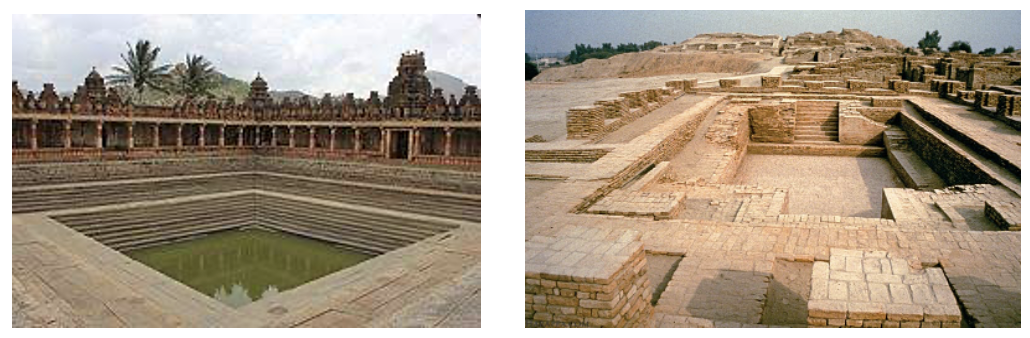
There is a structure known as the Great Bath of Mohenjo-Daro, shown on the right hand image above. It is thought that it was used for public rituals connected with the IVC religion. An interesting feature of this structure is the presence of a water tank, with steps leading down to the water. This is identical to the holy tanks built in Hindu Temples, called a pushkara in Sanskrit, and example of which is shown in the left image. The steps are also characteristic of pilgrimage spots in latter day India.
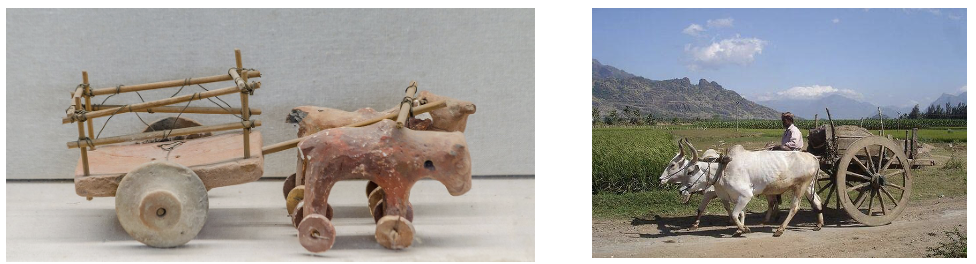
Wooden wheeled carts drawn by bullocks were in use in the IVC. Even though an actual cart has not been discovered, no doubt because the wood has rotted away, terracotta toys showing the vehicle have been found, an example of which is shown in the image on the left hand side. A modern bullock cart, which is in common use in Indian villages to this day, is shown on the right hand side. Jonathan Kenoyer, in his article on this subject remarks that:
The long continuity in cart designs of the Indus Valley and the fact that many different types of bullock cart continue to be used even today in Pakistan and India indicate that the original styles of cart were quite effective and that the early designers were able to produce a form that came to be improved upon only with the introduction of ball-bearing axles and rubber tires.
The period the 2000 to 500 BCE is when it is believed that the foundations of Hinduism were laid, and according to genetic data this is also the period when there was intense mixing going on between the populations of the IVC and the Yamnaya tribes. Hence it is quite conceivable that Hinduism is a religion that emerged as a synthesis of Yamnaya and IVC beliefs. Most experts on this topic believe that this is indeed the case, the Finnish Indologist Asko Parpola wrote a book called The Roots of Hinduism: The Early Aryans and the Indus Civilization on this topic and there is a nice review of it by Wendy Doniger. Parpola talks about his theory of how Hindiusm arose in this interview. The Rigveda was largely influenced by the Yamnaya, given its story of conquests, and emphasis on horse and chariot culture that the IVC did not have. However later Vedic religion embodied in epics such as the Ramayana and the Mahabharata show the influence of the IVC. Parpola sites several pieces of evidence in support of his thesis, among them the following:
Crocodiles, buffaloes, fig-trees, peacocks, and fish are important motifs of Early and Mature Harappan painted pottery, which are also among the principal religious symbols of village Hinduism. Parpola also notes that Vedic gods were not worshipped as images; they were heard, not seen. Hindu gods, by contrast, were worshipped as images, a practice that may well have been inherited from the IVC.
In contrast to the early Vedic Gods such Indra and Agni from the Rigveda, the later Vedic deities such Shiva, Vishnu and Krishna were depicted with dark skin, which also points to IVC influence. Kosambi also mentions in his book that Krishna was depicted as demon, an enemy of Indra, in the Rigveda, however by the time Alexander’s legions rolled through the Indus Valley in 326 BCE, the Greeks reported that the locals were worshipping a demi-God whose description matches that of Krishna. Hence by this time the cult of Indra had ended in the region, which marks a transition from the original Vedic religion to its later version under IVC influence.
Several Historians have pointed out that there is greater continuity in the traditions and customs at the village level as compared to those practiced by the elites in the society (from this point of view Kosambi’s practice of going to villages to do his research on ancient history makes a lot of sense). Local deities abound in the religious practices of villagers in current day India, and most of them are connected to natural features or rock microliths that have been around for thousands of years. These may very well have similarities with religion in the IVC, since one theory about the lack of religious structures in the IVC cities says that the people did their worshipping in nature, around sacred trees for example. Indeed images of the Pipal tree have been found in IVC seals, so the practice of worshipping this tree is very old.
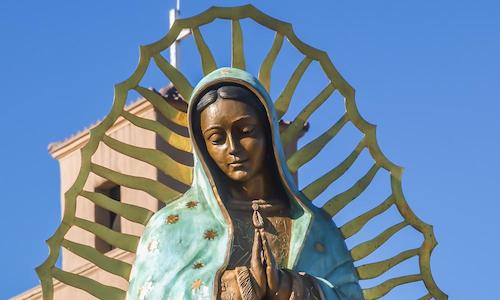
There is an interesting parallel between the evolution of religion in India after the IVC, and in Colonial Mexico after the Spanish conquest. I always assumed that Mexicans followed the Roman Catholic faith, but when I visited Mexico City a couple of years ago, I discovered that the most popular diety in Mexico is actually the Virgin of the Guadalupe who is depicted with brown skin (see image above), and there was no sign of the image of Christ in their churches. It turns out that initially after the conquest the Spanish tried to convert the natives to Christianity, but faced resistance. The Virgin of the Guadalupe became popular after she revealed herself in a vision to an Aztec peasant, a few decades after the Spanish conquest, and can be considered to be a synthesis of Christian and local beliefs. Once this change was made, the modified version of Christianity was accepted by the local population. Indeed a number of other Aztec Gods have entered the Mexican Christian pantheon since then, including the Corn Goddess and the God of Death, whose festival is the biggest religious celebration in Mexico. Something similar probably happened after the Yamnaya conquest of the IVC, with the combined people settling into a new belief system that combined their old beliefs.